
Why Mountain Villages Feel Different From Tourist Towns
There is a particular difference you can notice when travelling through the mountains. You can leave a busy hill town in the morning, drive for a while, and arrive somewhere only a short distance away where the atmosphere feels completely different. The roads may become narrower, shops may become smaller, and houses may begin appearing alongside fields, trees or steep slopes. People are walking somewhere because they actually need to get there, rather than because they are sightseeing.
In one place, you might find cafés, hotels, restaurants, souvenir shops, taxis and a steady stream of visitors. In another, you may see a small shop opening for the day, children heading to school, someone tending a field or neighbours talking outside a home. Both places can be in the mountains, yet they can feel remarkably different.
The difference is not simply about size or the number of tourists. It comes from what the place is primarily used for and how tourism fits into everyday life. Tourist towns have developed services and infrastructure around visitors, while mountain villages are primarily lived-in communities. People work there, study there, raise families there, run businesses there and adapt their routines to the terrain and seasons.
That distinction can change the way a traveller experiences a destination. Instead of moving from one attraction to another, you may find yourself noticing ordinary details: the way houses are arranged along a slope, how a road connects one part of a settlement to another, what a small shop keeps in stock or how the landscape changes behind someone’s home.
This is one reason mountain villages can offer such a different kind of travel experience. It is not necessarily better than visiting a tourist town. It is simply a different way of encountering a mountain destination.
What Actually Makes a Place a Mountain Village?
There is no single feature that determines whether a Himalayan settlement feels like a village rather than a tourist town. Some villages are very small, while others have grown considerably. Some depend heavily on agriculture or livestock, while others have increasingly diverse livelihoods. Some are close to major tourist destinations and receive regular visitors, while others see relatively little tourism.
What they often share is that they are residential communities first. Homes, local businesses, roads, fields, schools and community spaces exist primarily because people live and work there. Tourism may be present, but it is only one part of the picture.
This is an important distinction when thinking about Himalayan villages. A village is not simply a destination with fewer tourists. It is a place with its own routines and practical needs.
A small shop might stock groceries because local residents need them every day. A road may connect homes to schools, markets or neighbouring settlements rather than leading to a viewpoint. A field may be part of someone’s livelihood rather than an attractive patch of green for visitors to photograph.
The landscape is therefore connected to everyday life in ways that can be less obvious in a tourism-oriented town. Himachal Pradesh itself contains a wide variety of settlements and tourism environments, so it is useful to avoid treating every village as though it offers the same experience.
Tourist Towns Are Built Around a Different Rhythm
A well-established tourist town naturally develops around the needs of visitors. Hotels appear because travellers need somewhere to stay, restaurants and cafés expand because visitors need places to eat, and taxi services develop around sightseeing and transport. Shops may also begin carrying souvenirs, outdoor equipment and other products that tourists are likely to buy.
Over time, tourism becomes part of the town’s everyday rhythm. This does not make the place less authentic. A tourist town can still have long-established communities, local businesses, distinctive architecture, cultural traditions and ordinary residential neighbourhoods. It simply has a larger tourism economy operating alongside everyday life.
Dalhousie is a useful example of this broader distinction. It is an established hill destination where tourism is an important part of the experience, with accommodation, restaurants, transport and sightseeing infrastructure serving visitors. Travel into smaller, less tourism-oriented settlements can reveal a different balance, where everyday services and residential life become more prominent.
Neither experience is inherently superior. A tourist town can be convenient when you want choices, while a smaller settlement can be interesting when you want to notice how a place functions when tourism is not the main reason people are there.
In Mountain Villages, Everyday Life Is Often the Main Story
One of the biggest differences you may notice in a mountain village is that there may be fewer obvious attractions. There might not be a sign pointing towards the next must-see location or an itinerary telling you where you should be at a particular hour. Instead, the interesting details can be ordinary.
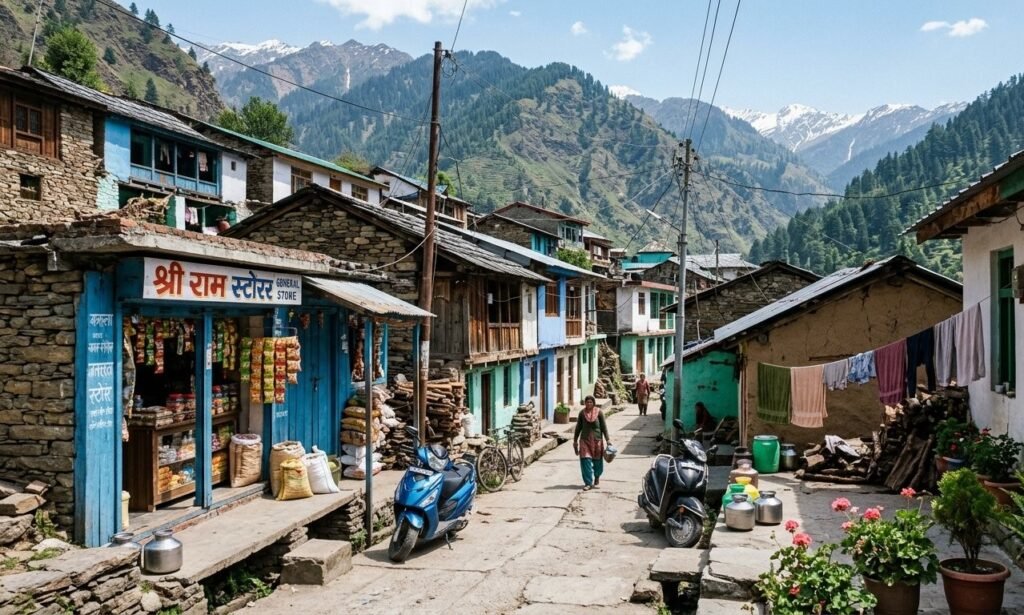
A shopkeeper opens the shutters in the morning. Someone walks along the road carrying groceries. Children make their way to school. A farmer works with seasonal crops. A local vehicle passes through the settlement, while neighbours stop to speak for a few minutes outside their homes. None of these activities has been arranged for visitors.
That is precisely why they can change the feeling of travelling. The experience comes from observing everyday life rather than constantly searching for something to see.
This requires a slightly different attitude from conventional sightseeing. You do not need to photograph every activity or turn ordinary residents into subjects simply because their surroundings look interesting. Sometimes the most valuable part of rural mountain travel is simply understanding that the place continues to function normally while you are passing through it.
You are seeing a community, not a stage.
The Pace Feels Different
A mountain village can sometimes feel slower, but this does not mean that people who live there have an easier or less demanding life. The difference is more about what the traveller encounters and how the day is structured from a visitor’s perspective.
A tourist town may give you a clear sequence of things to do: visit a market, stop at a viewpoint, have lunch, see an attraction and return to the hotel. A smaller settlement may offer fewer obvious reasons to move from one place to another. That can encourage a different pace.
You may walk without a fixed destination, spend longer looking at the way houses are built along a slope, stop at a small shop or simply sit somewhere for a while. You may also realise that there is no particular attraction you need to reach before sunset.
This connects naturally with the broader idea of slow travel. Slow travel is not simply about travelling slowly in a literal sense. It is about allowing enough time to understand where you are instead of treating the destination as a checklist.
For travellers interested in this approach, the idea also connects with , particularly the value of leaving enough space in an itinerary for the destination itself.
The Landscape Is Part of Everyday Life
There is an important difference between seeing mountains as scenery and seeing them as part of a lived environment. From a tourist viewpoint, a mountain may be something you stop to photograph. In a village, that same mountain may influence where people build homes, how roads are constructed, where fields can be cultivated and how people travel between settlements.
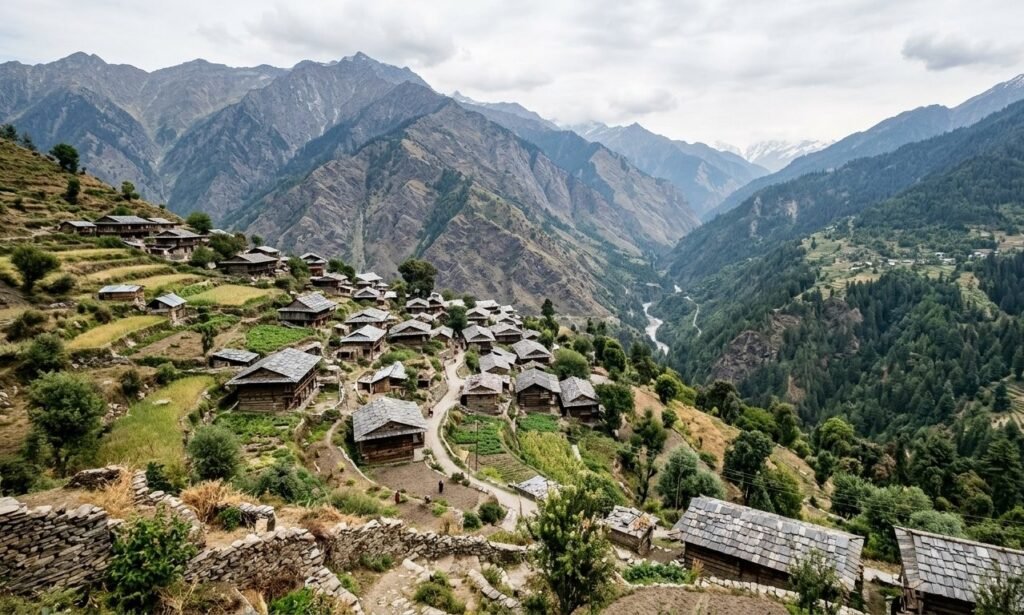
A slope is not simply a landscape feature. It can determine how a house is designed or where a road can reasonably be built. A road is not simply a scenic route; it can connect residents to schools, markets and neighbouring communities. A forest is not simply somewhere visitors go for a walk; it can form part of the wider environment surrounding homes and settlements.
Agricultural terraces, where present, can similarly reveal how people have adapted available land to mountain terrain. This is one of the more interesting aspects of life in mountain villages: the landscape is not separate from daily life, but part of the conditions within which daily life takes place.
Of course, this relationship differs greatly across the Himalayas. A settlement in Kinnaur will not necessarily look or function like one in Chamba, Kangra or another Himalayan region. Altitude, climate, terrain, local livelihoods and development patterns all influence how communities use the land around them.
Architecture Tells a Different Story
Buildings can also change the feeling of a place. In established tourist towns, you may see hotels, cafés, commercial buildings and newer construction alongside older homes. The architecture is often shaped by a combination of local traditions, modern requirements and tourism.
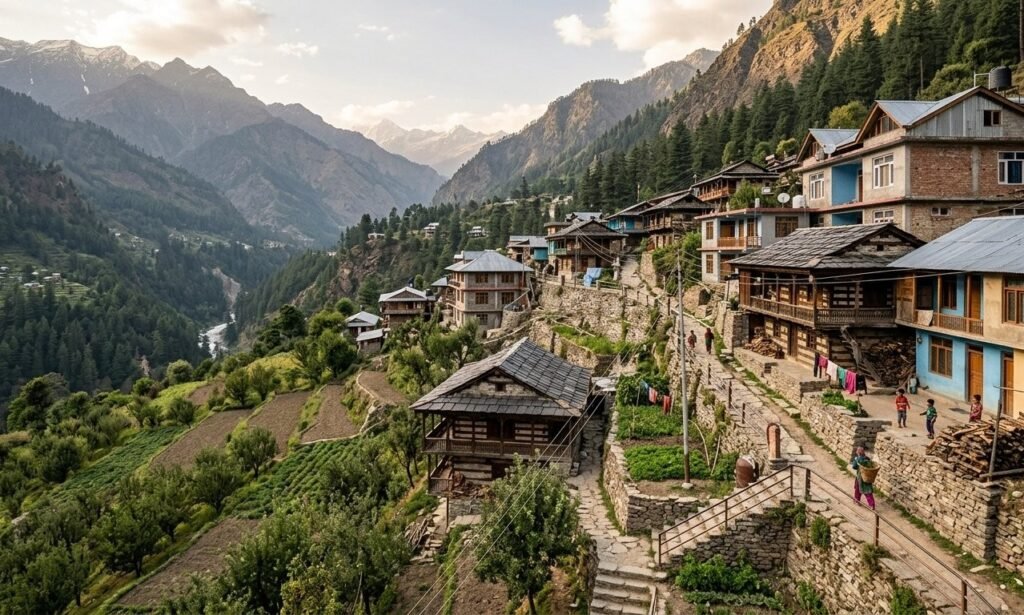
In mountain villages, residential buildings may be more visually prominent. You might notice homes arranged on uneven terrain, sloped roofs suited to local conditions, terraces built into hillsides, or traditional materials appearing alongside newer construction.
There is no single style that defines Himalayan architecture. Building traditions vary considerably from one region to another, and modern homes increasingly exist alongside older structures.
That mixture is important. A mountain village should not be expected to look like a preserved historical settlement. People living there need modern homes, better roads, connectivity, schools, shops and other services just like communities elsewhere.
What makes the architecture interesting is often the way buildings have adapted to their surroundings and changed over time.
Small Shops Can Tell You More Than a Souvenir Market
A souvenir market is designed, at least partly, around what visitors want to buy. A small village shop has a different purpose. Its first customers are usually the people who live nearby, so it may stock groceries, household items, snacks, basic supplies or products that reflect seasonal needs.
That makes the shop an interesting window into local mountain life. It shows what people actually need rather than what visitors are expected to want.
The same can apply to a small local eatery. Instead of a menu designed primarily around tourist expectations, you may encounter food that reflects what the business normally serves to its local customers. For travellers interested in authentic mountain experiences, these ordinary commercial spaces can sometimes be more revealing than a dedicated tourist attraction.
But there is an important boundary. A local shop is still someone’s workplace and a village is still someone’s neighbourhood. Observe respectfully, buy something if you genuinely need it, and avoid treating everyday businesses as if they were exhibits.
You Notice the Soundscape
Sound is one of the easiest ways to notice a change in environment. In a busy tourist town, the soundscape may include traffic, restaurant activity, visitors, music, vehicle horns and commercial activity.
In a smaller settlement, depending on the location and time of day, you may notice something different. Perhaps it is birds in the morning, footsteps on a narrow road, conversations outside a home, livestock nearby, wind moving through trees or the sound of a local vehicle passing.
That does not mean every village is quiet or every tourist town is noisy. A village can have traffic, construction, machinery and busy periods, while parts of a tourist town can be remarkably peaceful.
The difference is that the sounds you notice may be connected to different kinds of activity. For a traveller, this can make the environment feel less commercially organised and more closely connected to ordinary routines.
There May Be Fewer “Things to Do” — and That Can Change the Experience
Many travellers arrive in a destination with an expectation that a good trip should come with a long list of activities. Mountain villages can challenge that assumption. There may be fewer ticketed attractions, organised tours, shopping areas and entertainment venues specifically designed to keep visitors occupied.
At first, that can feel like a limitation. Then the experience changes.
Instead of asking what you should do next, you may begin noticing what is already around you. You walk, observe, eat, pause, notice the landscape and return when you feel ready.
This is not an argument for removing activities from travel. Some travellers genuinely enjoy busy itineraries, and established tourist destinations can be excellent for that style of holiday.
The point is simply that mountain village tourism can encourage a different definition of what counts as an experience. A conversation, a walk through the settlement, a local meal or an hour spent observing the landscape can become part of the trip without being a formal attraction.
The Difference Between Visiting a Place and Spending Time There
There is a subtle difference between seeing a destination and spending time within it. A conventional tourist-town day might naturally follow a sequence of attraction, viewpoint, restaurant, market and hotel. The structure works because the destination offers plenty of places designed to be visited.
A village experience may have less structure. You might walk, observe, pause, eat, explore a little and return. The day does not necessarily need to be built around a series of attractions.
The second approach is not automatically more meaningful. It is simply less dependent on scheduled sightseeing.
This is where the distinction between visiting a place and spending time there becomes useful. Sightseeing asks, “What should I see here?” Spending time somewhere asks, “What is this place like when I stop trying to see everything?”
That second question can be particularly interesting in smaller mountain communities. You may notice how the settlement connects to the surrounding landscape, where residential and commercial spaces meet, and which roads people actually use.
You are no longer simply collecting locations. You are developing a sense of place.
Why Mountain Villages Can Feel More Personal
Smaller communities can sometimes create more opportunities for human interaction simply because the scale of the place is different. But travellers should be careful about expecting guaranteed “authentic” encounters.
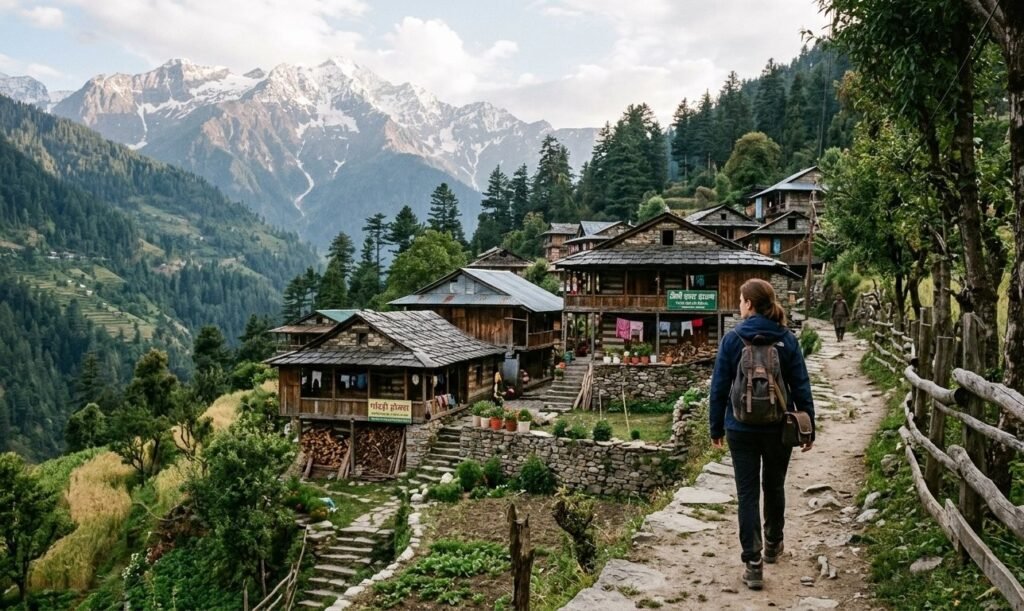
People living in mountain villages are not there to provide visitors with an experience. They have their own routines, responsibilities and boundaries. A meaningful interaction happens when both sides are comfortable with it.
That could be a brief conversation with a shopkeeper, asking about a local food item or speaking with someone who is providing a service. The important qualities are curiosity, patience and respect.
Ask before photographing people. Do not enter someone’s home or private property without permission. Avoid turning religious ceremonies or personal routines into content without understanding the local expectations.
Learning about a community is different from treating its culture as something to consume.
What Travellers Should Understand Before Visiting a Mountain Village
A little preparation can make travelling to mountain villages much easier. Smaller settlements can operate differently from established tourist centres, so travellers should adjust their expectations before arriving.
A few simple principles can help:
- Respect local privacy. A narrow path beside a house may look like an interesting walking route, but that does not mean it is public space. Stay on appropriate roads and paths, and do not enter private property without permission.
- Do not treat residents as attractions. People are not part of the sightseeing experience. If someone is working, walking home or spending time with family, allow them to continue without turning the moment into a photograph or interaction.
- Ask before photographing people. This is especially important with children, private homes, religious spaces and personal activities. A simple request is often enough, and if someone says no, accept it without argument.
- Support local businesses where appropriate. Travellers can contribute to local economies by using locally operated shops, restaurants and services when these meet their needs. There is no need to buy something simply because it is described as local; thoughtful purchasing is more useful than consumption for its own sake.
- Expect fewer tourist services. Some smaller settlements may have fewer options for transport, dining, cash access, medical services or connectivity than established tourist centres. The exact situation varies by destination, so research your specific route rather than assuming that every village has the same infrastructure.
- Carry sensible essentials. Depending on your destination and travel plans, consider carrying water, essential medication, weather-appropriate clothing, some cash and offline copies of important travel information. The goal is not to overpack but to avoid depending entirely on services that may not be immediately available.
Mountain Villages in Himachal Pradesh
Himachal Pradesh offers an especially useful example of how varied mountain settlements can be. The state contains major tourism centres, smaller hill towns, agricultural communities, forest settlements and villages increasingly influenced by tourism.
Some villages are located close to established destinations, while others are reached through longer mountain journeys. Some rely heavily on farming and local occupations, while others have developed guesthouses, cafés or other tourism-related businesses.
The experience therefore depends on much more than whether a place is officially described as a village. It can be shaped by altitude, geography, accessibility, the local economy, season, proximity to tourist centres and the degree of tourism development.
This is why it is better to think of village tourism in Himachal Pradesh as a broad category rather than a single type of holiday. The experience in one settlement may be very different from that in another, even when both are located within the same district.
For someone visiting the state for the first time, the can provide broader planning context. But a general guide cannot tell you exactly what a particular village will feel like.
That is something you discover by spending time there.
Choosing a Mountain Stay That Lets You Experience the Destination
Where you stay can influence how you experience a mountain destination. A room in a busy commercial centre places you close to restaurants, shops, transport and tourist services. That can be exactly what you want, particularly if convenience and easy access are priorities.
A quieter property away from the busiest part of a destination can create a different rhythm. You may spend more time around the accommodation, take a shorter walk rather than another long drive, or return earlier in the evening instead of staying out until the last attraction closes.
Neither approach is automatically better. The important thing is to choose accommodation that matches the type of trip you actually want.
This idea connects with , particularly the idea that accommodation and surroundings can become part of the experience rather than simply serving as a place to sleep.
For travellers interested in rural mountain travel, the setting of a stay can therefore matter almost as much as its practical features.
Experiencing the Mountains Through EVA Cabins
For travellers planning time around Dalhousie, EVA Cabins offers a cabin and homestay experience connected with the wider Himalayan setting. The accommodation can form one part of a broader trip that includes exploring the surrounding area, spending time outdoors and deciding how much of the day should be devoted to sightseeing.
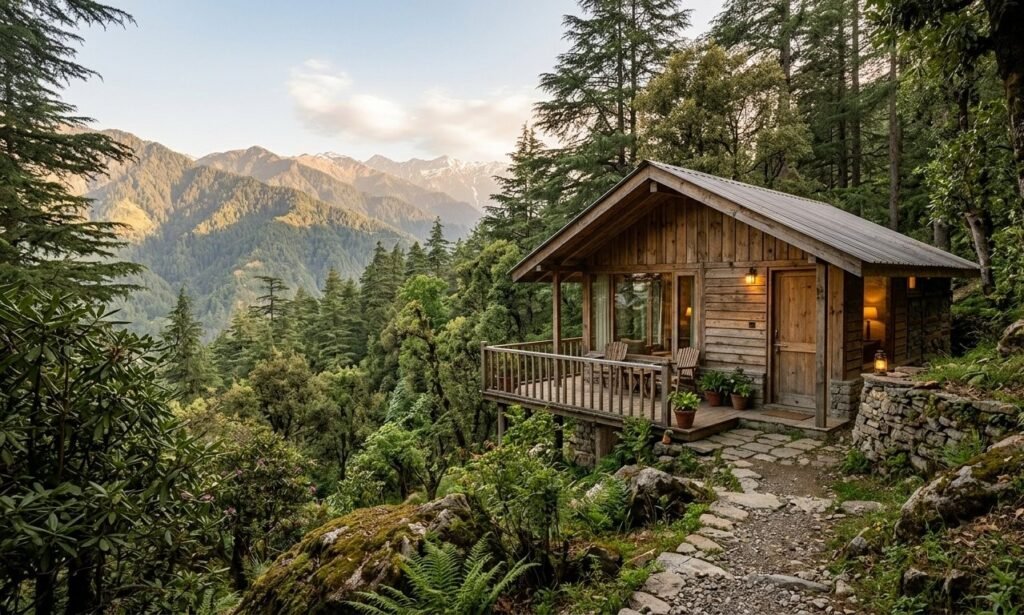
The important point is not to present a cabin stay as a substitute for experiencing local communities. Rather, accommodation can be one part of how you structure your time in the mountains.
A traveller who prefers a quieter experience might choose to combine a few outings with unplanned time around the stay instead of spending every day moving between attractions. That approach fits naturally with the broader idea behind slow travel: allowing the destination to shape part of the day rather than deciding in advance that every hour needs to be occupied.
If your plans include driving around the area, can help with the broader road-trip side of planning.
The key is still to choose based on your own travel style. A mountain stay should support the experience you want rather than dictate it.
Mountain Villages Are Not Just “Offbeat” Destinations
The word “offbeat” is often used to describe places that receive fewer visitors. But a mountain village is more than an alternative destination for travellers who have already seen the famous places.
Calling a village “offbeat” can sometimes make it sound as though its main value comes from being less discovered. That misses something important: these are lived-in places.
People have their own routines, businesses, responsibilities, relationships and reasons for being there. Their value does not depend on how many tourists know about them.
That distinction matters as rural tourism grows. If travellers begin visiting smaller communities in large numbers, the character of those places can change. Tourism can create opportunities, but it can also place pressure on infrastructure, privacy, everyday spaces and local resources.
This does not mean villages should be kept away from tourism. It means tourism should be approached with some awareness.
A traveller’s responsibility is not to make a village feel like a tourist attraction. It is to enter as a visitor and behave accordingly.
A Different Way of Looking at Mountain Travel
Perhaps the biggest difference between mountain villages and tourist towns is not what you can see. It is what you expect to find.
A tourist town encourages you to look for attractions. A village can encourage you to look at the place itself. You notice how people move through it, where homes meet roads, how shops serve local needs, how the landscape surrounds the settlement and how the rhythm of the day changes with weather and season.
That kind of observation requires very little from the traveller. You do not need specialist equipment, an expensive activity or a carefully planned itinerary. You simply need enough time to pay attention.
For travellers already interested in quieter Himalayan experiences, this can be one of the more rewarding aspects of Himalayan village life. The experience does not come from finding something that nobody else has seen. It comes from seeing an ordinary place with a little more attention.
Conclusion
A tourist town can make it easy to discover a mountain destination. It gives you restaurants, accommodation, transport, viewpoints, activities and plenty of practical choices.
A mountain village offers something different. It can show you what the mountains look like when they are not being arranged primarily for visitors. Homes sit alongside roads, shops serve residents, fields occupy available slopes, children go to school and businesses open and close according to ordinary routines.
That does not make villages universally quieter, more authentic or more enjoyable than tourist towns. It simply means the traveller’s relationship with the destination can change.
You stop looking only for the next attraction and start noticing the place itself.
That is perhaps the real appeal of mountain villages. They remind us that a destination does not have to entertain us every minute to be worth experiencing.
Sometimes the most interesting travel happens when there is nothing on the itinerary for the next hour. You walk, observe, pause, and allow the place to reveal itself at its own pace.
A tourist town may help travellers see a mountain destination. A mountain village can sometimes help them understand how a mountain destination is lived.
And sometimes, that difference is what makes a journey stay with you.
Frequently Asked Questions
1. What is a mountain village?
A mountain village is a smaller settlement located in a mountainous region where people live and work as a permanent community. It may include homes, local businesses, agricultural areas, schools, roads and community spaces. Tourism may be present, but it is not necessarily the settlement’s primary purpose.
2. How are mountain villages different from tourist towns?
Tourist towns generally have more infrastructure and services designed specifically for visitors, such as hotels, restaurants, sightseeing facilities and tourist-oriented shops. Mountain villages are primarily residential communities where tourism is usually one part of everyday life.
3. Why do mountain villages feel quieter than tourist towns?
Some smaller settlements have fewer visitor-oriented businesses, attractions and traffic, although this varies considerably. A village can still be busy, while parts of a tourist town can be very quiet. Time of day, season and location also influence what travellers experience.
4. What is village tourism in Himachal Pradesh?
Village tourism in Himachal Pradesh broadly refers to travel experiences involving rural and village communities across the state. The experience varies according to geography, local livelihoods, accessibility, season and how much tourism has developed in the area.
5. Is it better to stay in a village or a tourist town?
Neither is universally better. A tourist town may be more convenient for restaurants, transport and attractions, while a smaller settlement may suit travellers looking for a slower and more locally oriented experience. The right choice depends on your priorities.
6. What should you know before visiting a Himalayan village?
Research transport, accommodation, weather, connectivity and available services before travelling. Respect private property, ask before photographing people, follow local customs and avoid assuming that a village has the same facilities as a major tourist destination.
7. How can travellers support mountain communities?
Travellers can support local communities by using locally operated businesses and services where appropriate, purchasing products they genuinely need and treating residents and their everyday spaces respectfully.
8. Is village tourism suitable for first-time Himalayan travellers?
Yes, provided the destination matches the traveller’s expectations and practical needs. First-time visitors should research accessibility, available services, weather and accommodation carefully rather than assuming every Himalayan village offers the same travel conditions.