
Kalatop Wildlife Sanctuary: A Complete Guide for Nature & Wildlife Lovers
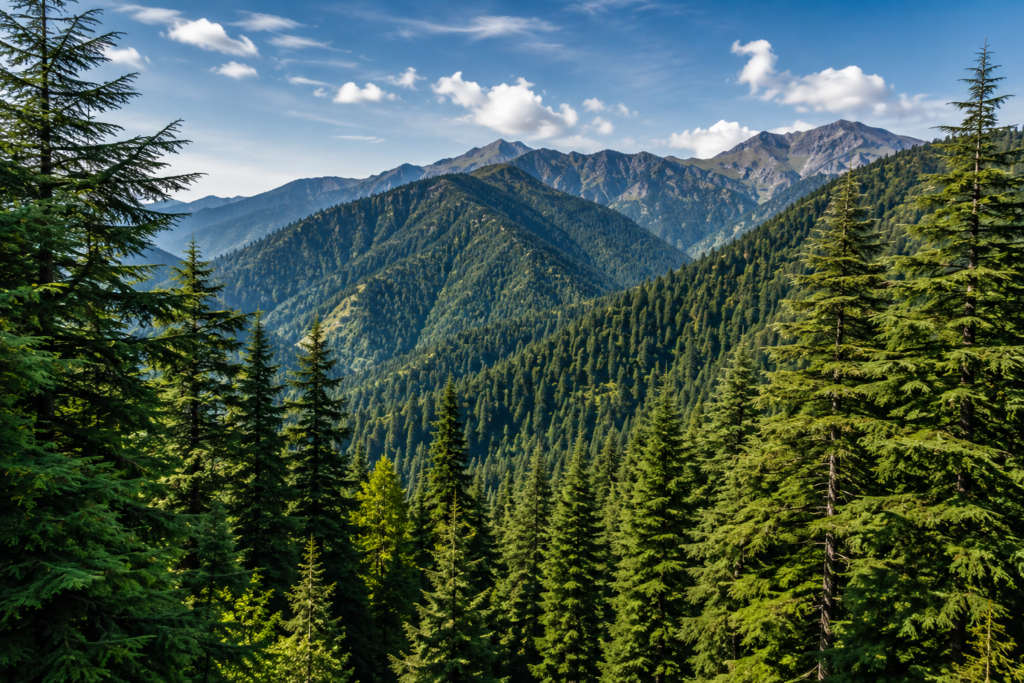
A short drive from Dalhousie can take you from a popular hill-station landscape into a much quieter world of dense forest, mountain slopes and protected wildlife habitat. Kalatop Wildlife Sanctuary is one of the most accessible protected natural areas in the Chamba region, yet its appeal lies less in guaranteed animal sightings and more in experiencing a genuine Himalayan forest environment.
The sanctuary forms part of the Kalatop-Khajjiar Wildlife Sanctuary, a protected area in Chamba district covering 17.17 sq km according to the Himachal Pradesh Forest Department. Himachal Tourism describes it as a dense forest landscape of blue pine, deodar, oak and rhododendron, with wildlife including leopard, Himalayan black bear, barking deer, goral and serow, along with several pheasant species.
For travelers staying in Dalhousie, Kalatop offers something different from a conventional sightseeing stop. You are not visiting a zoo or a managed wildlife park where animals are displayed for visitors. Instead, you are entering a natural forest ecosystem where wildlife remains wild, sightings are unpredictable and the forest itself is the main experience.
That distinction is important. A visit to Kalatop is best approached with patience rather than expectations of seeing a particular animal. Sometimes the reward is a glimpse of a bird moving through the canopy; at other times, it is simply the experience of walking through an old Himalayan forest without the noise and commercial activity found at busier tourist attractions.
What Is Kalatop Wildlife Sanctuary?
Kalatop Wildlife Sanctuary is the popular name used for the Kalatop section of the Kalatop-Khajjiar Wildlife Sanctuary in Chamba district, Himachal Pradesh.
The sanctuary was originally notified in 1958. Its boundaries and area changed over time, and the present protected-area figure listed by the Himachal Pradesh Forest Department is 17.17 sq km. The current management plan also identifies Kalatop-Khajjiar as a protected area managed primarily for habitat conservation and wildlife protection.
Kalatop gets its distinctive character from its dense forest cover. The Chamba district administration explains that the name refers to the dark, thick forest on the hilltop—literally associated with the idea of a “black cap.” The same source identifies deodar, kail, spruce and ban oak among the vegetation and notes that the forest provides habitat for wild animals and birds.
The sanctuary is also closely connected geographically with Khajjiar. Rather than thinking of Kalatop and Khajjiar as completely separate natural environments, it is more useful to understand them as different visitor experiences within and around the same broader protected landscape.
The Forest Department’s protected-area travel guide lists Kalatop–Khajjiar as an eco-trek route and also identifies the Lakkar Mandi–Palwani Mata–Jot route as an eco-trek in the sanctuary area.
Where Is Kalatop Wildlife Sanctuary Located?
Kalatop is situated in the Chamba district of Himachal Pradesh, between the Dalhousie and Khajjiar areas.
The official Himachal Tourism website lists Kalatop as approximately 13 km from Dalhousie. It also states that the sanctuary can be reached from both Dalhousie and Chamba.
Its location is one of its greatest advantages for travelers. You do not need to undertake a remote expedition to experience protected Himalayan forest. Instead, Kalatop can be incorporated into a Dalhousie sightseeing plan while still providing a noticeably more natural setting.
The sanctuary lies within the broader western Himalayan landscape and is associated with the catchment of the Ravi River. Its forested slopes, ravines, mountain meadows and mixed coniferous vegetation create habitat for a range of mammals and birds.
The protected area currently covers 17.17 sq km, according to the Himachal Pradesh Forest Department.
How to Reach Kalatop Wildlife Sanctuary from Dalhousie
For most travelers, the simplest approach is by road from Dalhousie towards the Kalatop–Khajjiar side of the region.
The route is more than just transportation. As you move away from the more developed parts of Dalhousie, the landscape becomes increasingly forested, making the journey itself part of the experience.
By Road
The official Himachal Tourism information identifies Kalatop as approximately 13 km from Dalhousie. However, the actual distance and travel time can vary depending on your starting point, route and road conditions.
A practical route generally takes travelers towards Lakkar Mandi and onward towards Kalatop. The Forest Department’s protected-area guide specifically identifies the Kalatop approach as part of the sanctuary’s visitor and eco-tourism network.
By Private Vehicle or Taxi
A private vehicle or local taxi is generally the most convenient choice for visitors staying in Dalhousie.
However, travelers should not assume that every road within the protected area is available for unrestricted tourist driving. The sanctuary management plan distinguishes between core forest areas and designated eco-tourism areas, including the path from Lakkar Mandi to Kalatop Forest Rest House and certain roads around the area.
Therefore, follow local forest instructions and do not drive beyond permitted areas.
On Foot and Forest Trails
Walking is an important part of experiencing Kalatop, but visitors should use recognised and permitted routes rather than creating their own trails.
The Himachal Pradesh Forest Department’s protected-area travel guide specifically lists Kalatop–Khajjiar among the area’s eco-treks. It also lists Lakkar Mandi–Palwani Mata–Jot as another eco-trek.
Trail conditions, accessibility and permissions can change, particularly after snowfall, heavy rainfall or forest-management activity. Check locally before setting out.
Quick Travel Information
| Information | Practical Guidance |
| District | Chamba, Himachal Pradesh |
| Protected area | Kalatop-Khajjiar Wildlife Sanctuary |
| Current official area | 17.17 sq km |
| Distance from Dalhousie | Approximately 13 km |
| Main access | Road via the Dalhousie–Khajjiar side |
| Nearby area | Khajjiar |
| Walking options | Designated eco-treks and permitted forest routes |
| Best approach | Local taxi/private vehicle + walking where permitted |
What Makes Kalatop Wildlife Sanctuary Special?
The first thing that makes Kalatop different is its forest.
This is not simply a viewpoint surrounded by a few trees. The sanctuary contains substantial forest habitat, including blue pine, deodar, oak and rhododendron. Himachal Tourism describes the area as a rich habitat of western Himalayan flora and fauna.
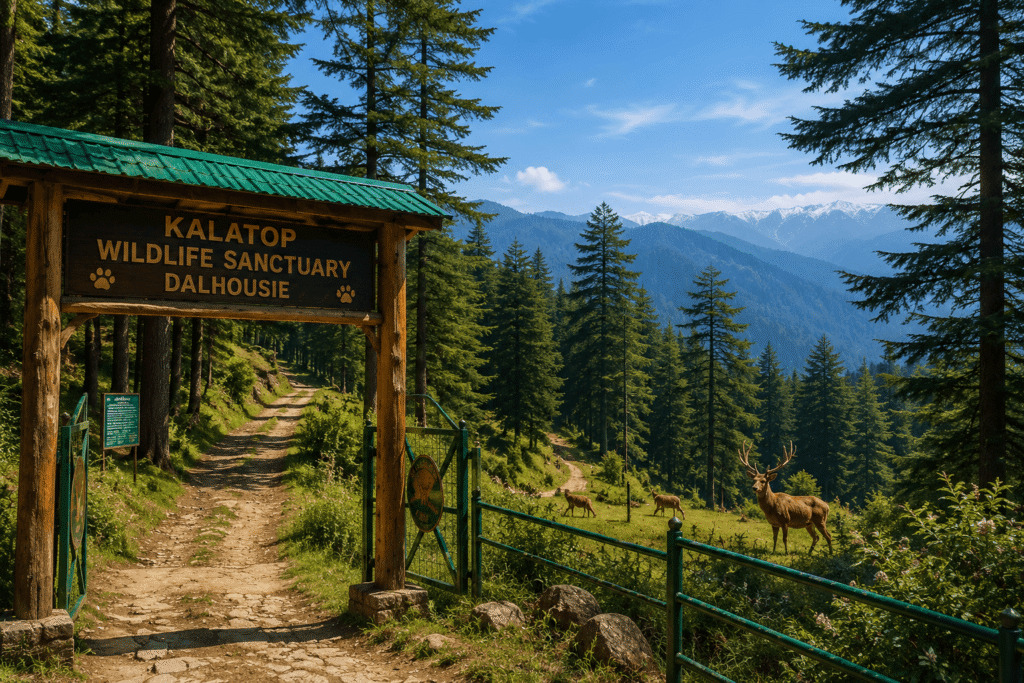
The second distinction is its accessibility. Wildlife experiences are often associated with remote national parks or long journeys into the mountains. Kalatop, by comparison, allows travelers based in Dalhousie to experience a protected forest without committing to a multi-day wildlife expedition.
The third is uncertainty.
You may see birds, hear movement in the undergrowth or notice signs of animal activity. You may also spend hours without seeing a large mammal. That unpredictability is not a weakness—it is part of experiencing a genuine wildlife habitat.
The sanctuary’s management plan specifically emphasises conservation, habitat management and species monitoring while also recognising the pressure created by tourism.
For visitors, that means the best experience comes from treating Kalatop as a living ecosystem rather than an attraction designed around guaranteed sightings.
Wildlife You May Encounter at Kalatop
Wildlife is one of the biggest reasons travelers search for a wildlife sanctuary in Himachal Pradesh, but realistic expectations are essential.
The official Himachal Tourism website lists leopard, black bear, barking deer, goral and serow among the mammals associated with Kalatop-Khajjiar Sanctuary. It also mentions pheasants including Cheer and Kalij.
The sanctuary’s management plan additionally documents species including musk deer, Himalayan black bear, leopard, barking deer and goral, along with birds such as Himalayan monal, Koklass, Cheer and Kalij pheasants and Chukar.
Himalayan Black Bear
The Himalayan black bear is among the most notable mammals associated with the sanctuary.
However, seeing one should never be treated as a normal sightseeing expectation. Bears are wild animals, and their movement depends on habitat conditions, food availability, weather and season.
If you encounter wildlife, maintain distance and follow instructions from forest personnel.
Leopard
Leopards are also documented in the sanctuary. They are elusive, predominantly active away from busy visitor areas and extremely difficult to spot casually.
A traveler should never enter the forest expecting a leopard sighting.
Goral and Serow
Goral and serow are mountain ungulates adapted to steep terrain. Their presence is one reason the sanctuary’s forest and rugged mountain habitat are ecologically important.
Again, however, the existence of a species in the sanctuary does not mean an individual animal will appear during your visit.
Barking Deer and Other Mammals
Barking deer and other smaller forest mammals form part of the sanctuary’s documented fauna. Their movements through dense vegetation make them easier to hear or detect indirectly than to photograph.
Himalayan Birds and Pheasants
Birdlife is another major attraction.
The official sources identify Himalayan monal, Koklass pheasant, Cheer pheasant and Kalij pheasant among the birds associated with the sanctuary.
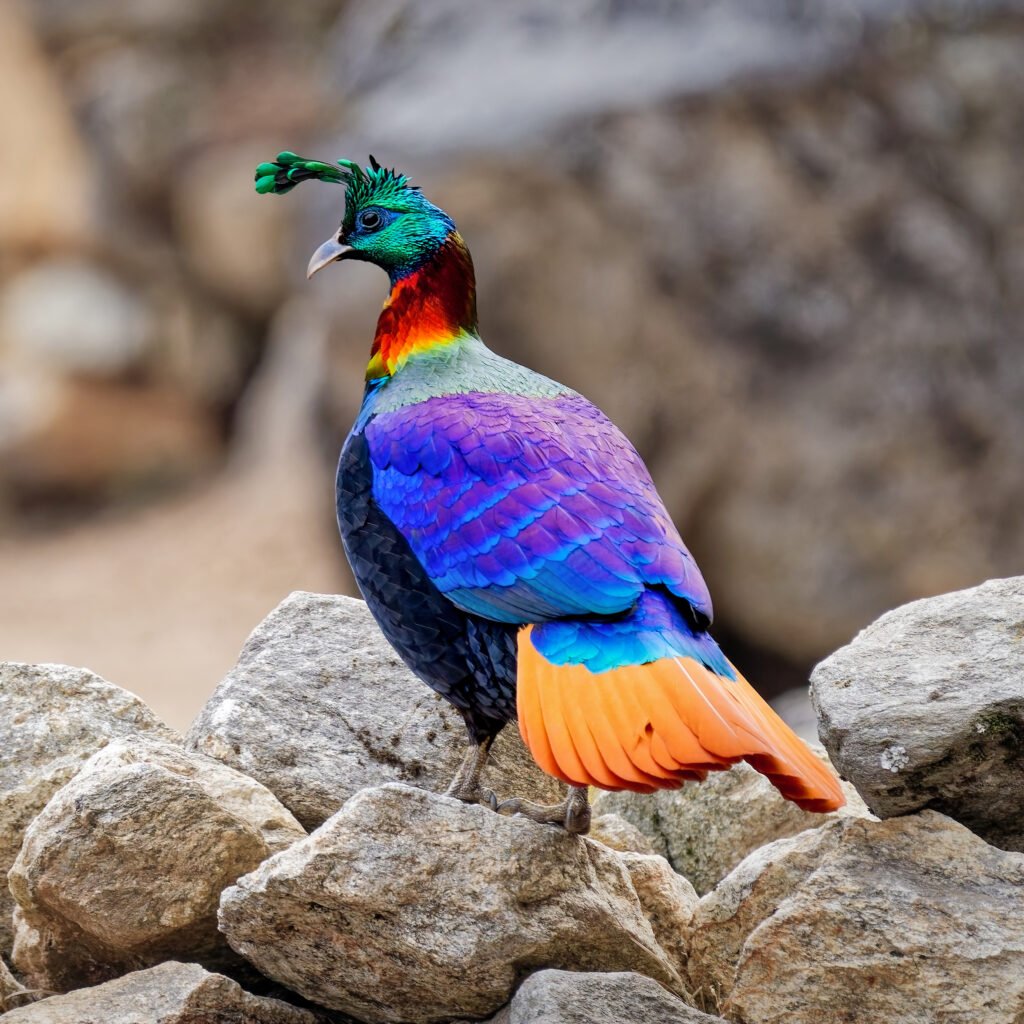
For bird and wildlife enthusiasts, this makes Kalatop particularly interesting because the objective is observation rather than simply collecting photographs.
Remember: wildlife sightings are never guaranteed. Season, weather, time of day, visitor activity, habitat conditions and animal behaviour all influence what you may encounter.
Forests and Flora of Kalatop
The forest ecosystem is arguably the sanctuary’s most consistent attraction because, unlike wildlife, it is always present.
Official tourism information describes the vegetation as including blue pine, deodar, oak and flowering rhododendron. The Chamba district administration also identifies deodar, kail, spruce and ban oak among the forests around Kalatop.
The Forest Department’s management documentation further identifies cedar, ban oak and blue pine among the important forest communities in the Kalatop-Khajjiar landscape.
These forests do much more than create beautiful scenery. They provide shelter, food and movement corridors for wildlife while helping maintain the wider mountain ecosystem.
As you walk through the forest, look beyond individual trees. Notice changes in vegetation, canopy density, ground cover, small streams and the transition between forest and open areas.
That broader perspective helps explain why protecting the habitat matters even when no animals are visible.
Things to Do in Kalatop Wildlife Sanctuary
Kalatop is best experienced through activities that encourage observation rather than disturbance.
Nature Observation
Slow down and pay attention to the forest.
Listen for bird calls, watch movement in the canopy and observe changes in vegetation. Even without spotting a large mammal, this can be an engaging nature experience.
Wildlife Spotting
Wildlife spotting requires patience.
Instead of walking quickly while looking only for large animals, observe tracks, sounds, movement and bird activity. However, never approach animals or attempt to lure them into view.
Photography
Kalatop provides opportunities for landscape, forest and wildlife photography.
The dense canopy creates a different photographic environment from open mountain viewpoints. Look for patterns created by tree trunks, shafts of light, mist, changing foliage and natural textures.
Walking on Permitted Trails
Walking through recognised routes is one of the most rewarding ways to experience the sanctuary.
The Forest Department lists Kalatop–Khajjiar and Lakkar Mandi–Palwani Mata–Jot among the area’s eco-trek routes.
However, route conditions and permissions should always be checked locally.
Quiet Forest Experiences
Sometimes the best activity is simply spending time without rushing.
Sit quietly at an appropriate location, observe the forest and allow yourself to experience the environment without constantly moving from one attraction to another.
Best Time to Visit Kalatop Wildlife Sanctuary
There is no single season that is perfect for every visitor.
Your ideal time depends on whether you prioritise comfortable walking conditions, greenery, clear mountain views or a quieter atmosphere.
Spring
Spring brings fresh vegetation and generally comfortable conditions around the Dalhousie region.
It is a pleasant period for walking and nature observation, although weather in the mountains can still change quickly.
Summer
Summer is one of the busiest travel periods around Dalhousie and Khajjiar. The sanctuary management plan notes particularly heavy tourist pressure during the warmer months.
If visiting during this period, an early start can help you experience the forest before visitor activity increases.
Monsoon
The monsoon brings moisture, mist and lush vegetation to the hills.
However, rain can affect road and trail conditions. Slippery surfaces, reduced visibility and temporary access restrictions are all possibilities in mountain environments.
Check local conditions before travelling.
Autumn
Autumn can offer pleasant conditions and clearer mountain landscapes after the monsoon period.
It is a strong choice for travelers who want to combine forest walks with broader sightseeing around Dalhousie and Khajjiar.
Winter
Winter changes Kalatop considerably.
The official Himachal Tourism site notes that Kalatop can receive heavy snowfall, with snow accumulation occasionally becoming substantial.
Road access and walking conditions can therefore change significantly during winter. Always confirm conditions before making a dedicated trip.
Kalatop Wildlife Sanctuary Timings and Entry Fee
This is one area where travelers should be careful with information found online.
Current official Himachal Pradesh Forest Department and tourism pages confirm the sanctuary’s protected status, area and general visitor information, but they do not currently publish a definitive visitor timetable and current fee schedule that can be safely quoted as a fixed amount.
Older travel sources and commercial tourism websites publish different figures for entry, forest-reserve permits and vehicle access. Those figures should not be treated as current without confirmation.
What should you do before visiting?
Before leaving Dalhousie:
- Confirm the current access arrangements with the local forest/wildlife authorities.
- Ask whether a forest or vehicle permit applies to your intended route.
- Confirm whether any particular trail or area is currently open.
- Check road conditions, especially during monsoon and winter.
- Follow any temporary restrictions issued by the Forest Department.
This approach is more reliable than planning around an old online fee or timing.
For official information, travelers can refer to the Himachal Pradesh Forest Department and the District Chamba administration.
Rules and Responsible Wildlife Tourism
A sanctuary is not simply a recreational forest. It is protected habitat.
The Kalatop-Khajjiar management plan specifically aims to regulate tourism without compromising conservation and calls for a low-volume, enriching wilderness experience. It also identifies tourism pressure and waste management as important management concerns.
That makes responsible behaviour particularly important.
Do Not Feed Animals
Feeding wildlife can alter natural behaviour and make animals associate people with food.
Maintain Distance
Never move closer to an animal for a photograph.
Use a longer lens rather than trying to physically reduce the distance.
Keep Noise Low
Loud music, shouting and unnecessary noise can disturb wildlife and reduce the quality of the experience for other visitors.
Do Not Litter
Carry reusable containers where practical and take your waste back with you if suitable disposal facilities are unavailable.
Stay on Permitted Routes
Do not enter restricted forest areas simply because a path appears accessible.
Never Approach Young Animals
If you see a young animal, assume its mother may be nearby. Move away rather than attempting to photograph or interact with it.
Respect Forest Personnel
Forest staff manage an area where conservation takes priority over sightseeing convenience. Follow their instructions even if they differ from what you expected.
Photography Tips for Kalatop
Kalatop rewards photographers who are willing to slow down.
Dense forests create lower and more variable light than open mountain viewpoints. A camera that performs well in low light can therefore be useful.
For wildlife photography, a telephoto lens is preferable because it allows you to photograph animals without approaching them.
For landscapes, wider lenses can capture the scale of the forest and surrounding mountains. However, do not focus only on panoramic compositions. Close details such as bark, leaves, moss, branches and filtered light can tell a stronger story about the forest ecosystem.
If you are hoping to photograph birds, patience is more valuable than constantly changing locations.
Most importantly, never use food, artificial sounds or aggressive pursuit to attract wildlife for a photograph.
A photograph is not worth disturbing an animal.
What to Carry for a Visit to Kalatop
A short visit does not require excessive equipment, but a few practical items can make the experience more comfortable.
Kalatop Visitor Checklist
- Comfortable walking shoes
- Drinking water
- Weather-appropriate layers
- Light rain protection during wet weather
- Sunglasses
- Sunscreen
- Binoculars for wildlife and bird observation
- Camera and spare battery
- Power bank
- Basic first-aid supplies
- Personal medication
- Identification documents if required
- Reusable bag for carrying personal waste
Avoid carrying unnecessary single-use plastic or anything that could become litter.
Kalatop Wildlife Sanctuary vs Other Nearby Nature Experiences
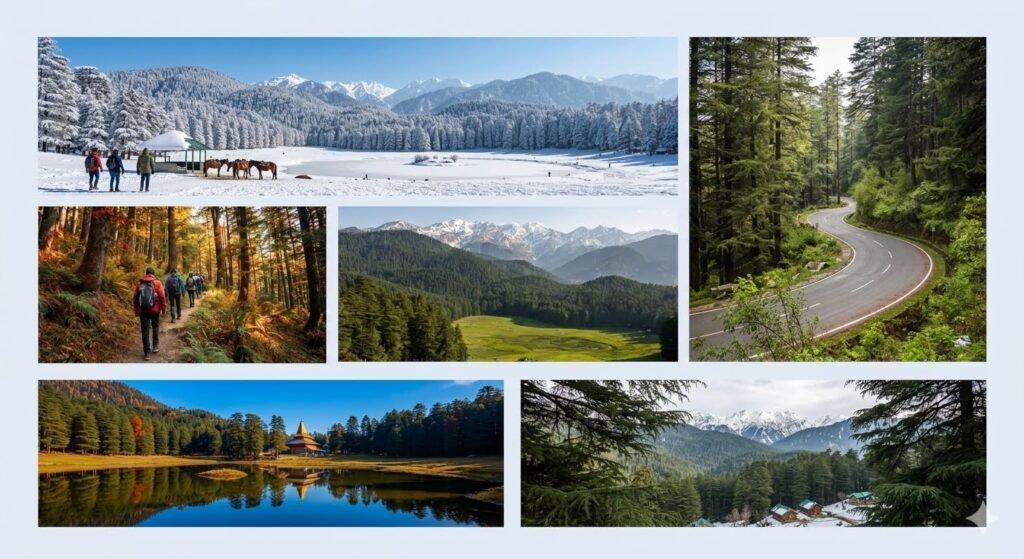
Kalatop is worth visiting precisely because it offers a different type of experience from other popular destinations around Dalhousie.
| Destination | Main Experience | Best For |
| Kalatop Wildlife Sanctuary | Protected forest and wildlife habitat | Nature lovers, wildlife enthusiasts, photographers |
| Khajjiar | Open meadow, cedar forest and scenic landscape | Families, couples, relaxed sightseeing |
| Dalhousie forests | Accessible forest walks and mountain scenery | Casual nature experiences |
| Chamba region | Broader combination of forests, valleys and cultural attractions | Longer regional exploration |
Khajjiar, for example, is known for its open meadow and surrounding cedar forest, while Kalatop provides a more distinctly protected-forest experience. The two can therefore complement each other rather than compete with one another.
How to Include Kalatop in a Dalhousie Itinerary
Kalatop does not necessarily need an entire day by itself.
Depending on your interests, you can build a half-day forest visit or combine it with Khajjiar.
Half-Day Visit
Start from Dalhousie in the morning and travel towards Kalatop.
Spend time exploring permitted forest areas, observing birds and enjoying the landscape. Allow enough time for the return journey rather than treating the sanctuary as a quick photo stop.
This option works particularly well for travelers who also want time to explore Dalhousie later in the day.
Full-Day Nature Experience
For a slower experience, devote most of the day to the Kalatop–Khajjiar landscape.
Spend the morning around Kalatop, have lunch in the broader Khajjiar area and then explore the meadow and surrounding landscape before returning to Dalhousie.
This approach avoids the rushed feeling of trying to visit too many attractions.
Combining Kalatop with Khajjiar
This is one of the most logical combinations because both destinations are connected geographically and through the wider sanctuary landscape.
The Forest Department’s protected-area guide identifies Kalatop–Khajjiar as an eco-trek route, while its travel information gives approximately 3 km from Dalhousie to Kalatop after the Dalhousie approach and 12 km from Kalatop to Khajjiar.
If you intend to walk the route rather than simply drive between destinations, check current trail conditions and local guidance before setting out.
Where to Stay When Exploring Kalatop
Choosing accommodation in Dalhousie gives travelers a practical base for exploring Kalatop, Khajjiar and other parts of the Chamba region.
For nature-focused travelers, the accommodation experience can also complement the day’s sightseeing. After spending hours outdoors, returning to a quiet setting can feel very different from staying in a busy commercial part of town.
EVA Cabins offers cabin accommodation in a nature-focused setting in Dalhousie, making it suitable for travelers who want to combine local sightseeing with a more peaceful place to return to.
The idea is simple: spend the day exploring the forests and landscapes around Kalatop, then come back to a comfortable cabin and slow down.
If your itinerary includes several nature experiences around Dalhousie, a peaceful base can make the entire trip feel less rushed.
Plan Your Kalatop Wildlife Sanctuary Visit
If you’re planning to explore Kalatop Wildlife Sanctuary, make your stay part of the experience. Choose a comfortable base in Dalhousie, plan your forest visit around current local conditions, and leave enough time to appreciate the landscape rather than rushing between attractions.
Stay at EVA Cabins and enjoy a peaceful nature-focused base while exploring Kalatop, Khajjiar and the wider Dalhousie region.
Conclusion
Kalatop Wildlife Sanctuary is not a destination you should visit with a checklist demanding a bear, leopard or rare pheasant sighting.
Its real appeal is the opportunity to experience a protected Himalayan forest that remains close enough to Dalhousie for a practical day excursion. The dense deodar, pine and oak forests, mountain terrain and documented wildlife make it one of the region’s most interesting nature experiences.
For wildlife enthusiasts, the possibility of seeing an animal adds excitement. For photographers, the forest creates a completely different visual environment from Dalhousie’s open viewpoints. For families and couples, meanwhile, the sanctuary provides a quieter alternative to spending an entire day around crowded tourist attractions.
Most importantly, visit with the right expectations.
Wildlife belongs to the forest, not to the visitor. Keep your distance, follow forest regulations, avoid litter, respect restricted areas and allow the landscape to reveal itself at its own pace.
When combined with Khajjiar and a comfortable stay in Dalhousie, Kalatop can become one of the most rewarding parts of a Himachal holiday—not because it guarantees spectacular encounters, but because it gives you the chance to experience the Himalayan environment on its own terms.
Frequently Asked Questions
1. Where is Kalatop Wildlife Sanctuary located?
Kalatop Wildlife Sanctuary is in Chamba district, Himachal Pradesh, within the Kalatop-Khajjiar Wildlife Sanctuary. It lies between the Dalhousie and Khajjiar areas.
2. How far is Kalatop from Dalhousie?
Himachal Tourism lists Kalatop at approximately 13 km from Dalhousie. Actual road distance can vary depending on the starting point and route.
3. What animals are found in Kalatop Wildlife Sanctuary?
Documented wildlife includes Himalayan black bear, leopard, barking deer, goral and serow. The sanctuary also supports several pheasant species and other birds.
4. Can you see wildlife at Kalatop?
Wildlife can be encountered, but sightings are never guaranteed. Animals are wild and their visibility depends on season, weather, habitat conditions, time of day and behaviour.
5. What is the best time to visit Kalatop Wildlife Sanctuary?
The best period depends on your interests. Spring, summer and autumn can provide comfortable conditions for exploring, while winter can bring snow and more difficult access. Always check current weather and road conditions.
6. What are the Kalatop Wildlife Sanctuary timings?
Current official tourism and Forest Department pages do not provide a definitive visitor timetable that can be safely treated as a fixed daily schedule. Confirm the current access timings locally before travelling.
7. What is the Kalatop Wildlife Sanctuary entry fee?
The current official sources available do not publish a definitive visitor fee that should be quoted as a fixed current price. Older online sources report different fees and permit arrangements, so travelers should confirm the applicable fee or permit requirements with the local forest authorities.
8. Is Kalatop suitable for families?
Yes, provided families follow forest rules and choose suitable permitted routes. Children should remain supervised, especially in forested areas and around any wildlife.
9. Can Kalatop and Khajjiar be visited together?
Yes. The two destinations are closely connected geographically, and the Forest Department identifies Kalatop–Khajjiar as an eco-trek route.
10. Can you go trekking in Kalatop?
Walking and trekking are possible on recognised routes, including the Kalatop–Khajjiar eco-trek listed by the Forest Department. Visitors should confirm current trail conditions and permissions before starting.
11. Is photography allowed in Kalatop?
Photography is generally part of the visitor experience, but wildlife photography must be conducted responsibly. Do not approach animals, use food to attract them or enter restricted areas for a better photograph.
12. What should I carry to Kalatop?
Carry comfortable walking shoes, water, weather-appropriate clothing, basic personal medication, a phone or camera, power bank and binoculars if you enjoy wildlife observation.